
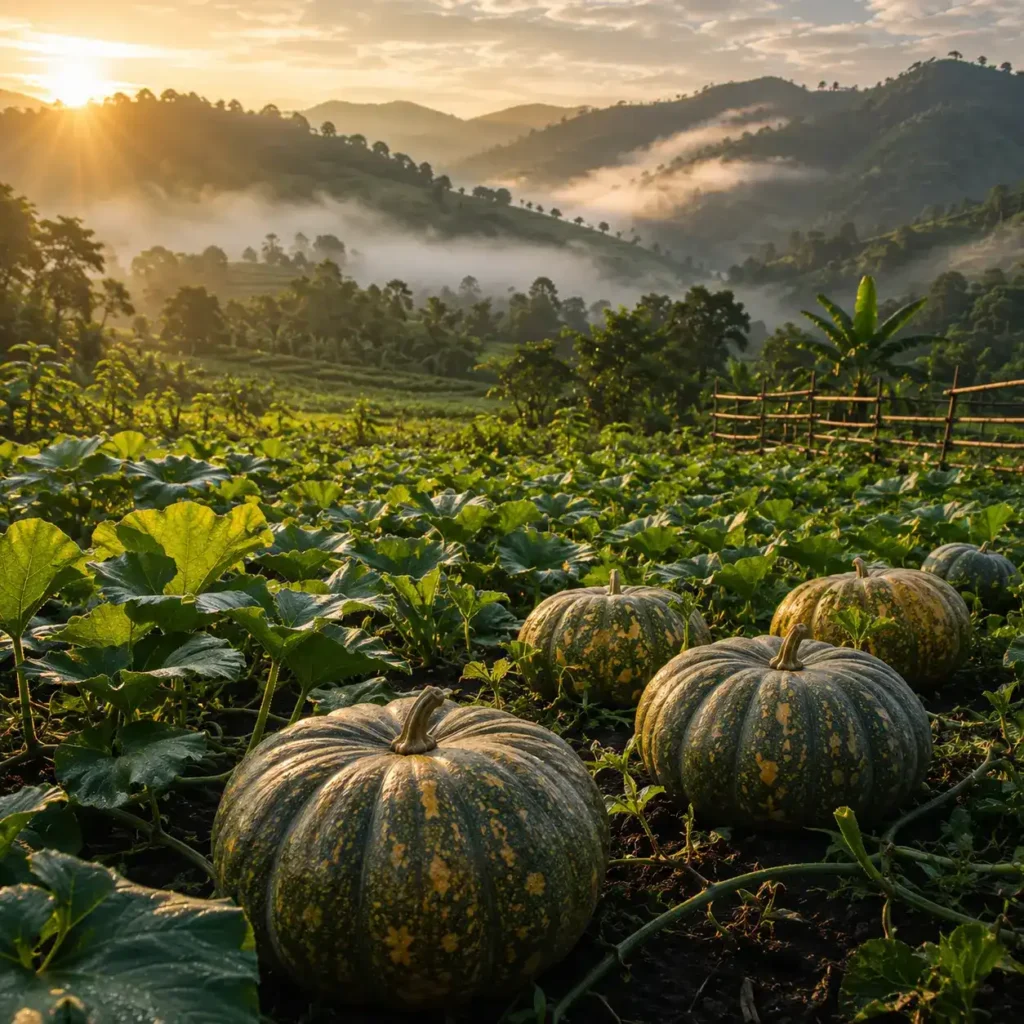
If you follow the crowd, your strategy for pumpkin farming in northeast india will probably center on the dry, comfortable October window. But doing what everyone else does leads straight into a saturated winter market where wholesale prices crash.
The real financial breakthrough comes when you buck convention and plant during the intense humidity of July and August along our fertile riverbanks. It feels counter-intuitive—most traditional growers will tell you that the monsoon will turn your fields into a rotting swamp.
However, by navigating this specific window, nature handles your watering for you, slashing your overhead irrigation setup costs by 65%. More importantly, it perfectly positions your harvest right into the lucrative pre-winter market gap when fresh produce supplies across urban centers plummet. Successfully executing pumpkin cultivation in northeast india requires moving away from casual broadcasting and mastering precise pit engineering and biological crop management.
The Ground Realities
Farming in the Northeast is never a one-size-fits-all equation; the river valleys of Assam demand a completely different operational playbook than the steep terrains of Meghalaya or Mizoram.
| Operational Groundwork | Alluvial Plains | Mid-Hill Terraces |
|---|---|---|
| The Sowing Window | July 15 – August 30 (Off-Season) | April 15 – May 15 (Pre-Monsoon) |
| Seed Volume (Per Acre) | 600g – 800g (Direct Pit Sowing) | 1.0 kg (Nursery Protrays) |
| Real Production Cost | ₹18,000 – ₹22,000 per acre | ₹25,000 – ₹28,000 per acre |
| Expected Tonnage Output | 9,500 kg – 12,000 kg | 7,500 kg – 9,000 kg |
| Wholesale Price Floor | ₹18 – ₹32 per kg (Off-season peak) | ₹12 – ₹18 per kg |
| Days to Harvest | 95 – 110 Days | 115 – 130 Days |
Boots-on-the-Ground
- The Silt Pit Method: Forget flat tilling; it suffocates pumpkin roots in heavy rain. Excavate dedicated pits measuring 30cm on all sides, spaced 3 feet apart within rows and 10 feet between rows. Pack each pit with 5 kg of rich, well-matured farmyard manure mixed with 50g of neem cake to build a warm, disease-resistant micro-environment for the roots.
- Mound Engineering: In heavy rainfall belts, build soil into raised, circular mounds a foot high over each pit. Plant 2 to 3 seeds per spot. On day 12, take a pair of shears and clip the weaker seedlings at the base. Never pull them out by hand—the friction tears the delicate root network of the surviving vine.
- The Flower Balancing Trick: Pumpkin vines naturally waste immense energy pushing out useless male flowers early on. Spray Ethrel at 250 ppm (2.5 ml in 10 liters of water) four times at weekly intervals starting from the 15th day. This safely triggers an explosion of early female flowers, increasing your fruit-bearing capacity by up to 40%.
Beyond Raw Produce
Raw pumpkins are heavy, bulky, and expensive to transport across challenging regional terrains. The true secret to scaling a pumpkin farming business is breaking away from selling only raw gourds and tap into their incredible culinary versatility through small-scale processing.
Dehydrating the dense flesh and milling it into a premium, gluten-free powder extends shelf life to a full year. This converts a highly perishable harvest into a steady, non-perishable revenue stream—a massive operational advantage for commercial pumpkin farming in northeast india.
Additionally, local culinary traditions make pumpkin cultivation in northeast india uniquely profitable. Regional markets highly value tender vine tips and blossoms for daily stews, meaning you can prune your vines for optimal fruiting while selling the trimmings as an immediate, high-demand cash crop.
Finally, never discard the seeds. Cleaning, slow-roasting, and packaging them creates a premium wellness snack that easily commands triple the market price of the raw fruit, rendering your entire pumpkin farming enterprise completely zero-waste.
The Roadblocks
There is nothing worse than watching a stunning, vigorous green canopy vanish overnight. Within the first two weeks of sprouting, the Red Pumpkin Beetle can decimate an entire acre of a budding pumpkin farming venture by stripping the baby cotyledons bare.
- The Pollinator Trap: Standard textbook advice tells you to spray heavy chemical insecticides. Don’t do it. In our organic northeastern ecosystems, chemical residues completely wipe out the native honeybees. When your female blossoms open a few weeks later, there will be no pollinators left, causing the unfertilized blossoms to turn yellow and drop off by the hundreds. Protect your early vines safely by dusting them with clean morning wood ash or a 3% neem oil mist at dawn when beetles are sluggish.
- The second point of sheer frustration happens right at the finish line. A heavy, beautiful pumpkin resting directly on damp, rain-soaked alluvial silt will develop water-blisters and fungal belly-rot within days. Growers routinely lose up to a quarter of their harvest weight right before market day to this oversight. The fix is beautifully simple: the moment a gourd reaches the size of a fist, gently slide a flat piece of local slate stone, a tile, or a thick cushion of dry thatch grass underneath it to break direct ground contact.
Level Up Your Farming
Stop guessing about shifting weather patterns, unpredictable monoons, and erratic seed availability. Download our practical, boots-on-the-ground organic tracking log, featuring direct hybrid sourcing networks and real-world processing metrics tailored specifically for growers in Assam, Meghalaya, and surrounding hill states. Get Immediate Blueprint Access.