
PREMIUM FEASIBILITY TOOLS
Mushroom ROI Calculator
Estimate fresh yields, production expenses, and net profit margins across cultivation cycles.
120 bags
Estimated Net Profit
₹0
0% Net Margin
Total Fresh Yield
0 kg
Gross Revenue
₹0
Total Batch Cost
₹0
Production Cost / kg
₹0
Mushroom ROI Calculator: Input Breakdown
Scaling a commercial or homestead mushroom project requires accurate unit economics. Profitability in mushroom cultivation is not dictated solely by bag count; it depends on Biological Efficiency (BE%), substrate conversion rates, contamination margins, and direct-to-consumer versus wholesale market liquidation.
Key Drivers of Mushroom Farming ROI
- Substrate Moisture Optimization: Substrate prepared below 60% moisture leads to underdeveloped pinheads and premature drying. Moisture above 70% increases anaerobic bacteria and green mold (Trichoderma) risk.
- Spawning Rate Efficiency: An inoculation rate of 2% to 4% of wet substrate weight guarantees rapid mycelial colonization, closing the window for competitor spore establishment.
- Environmental Control: Fruiting bodies require 80% to 90% relative humidity with constant fresh air exchange (keeping CO2 below 1,000 ppm) to prevent leggy stems and small caps.
- Processing & Dehydration Margins: Dehydrating excess fresh mushrooms (using a 10:1 wet-to-dry weight ratio) provides shelf-stable inventory, preserving margins when daily market demand fluctuates.
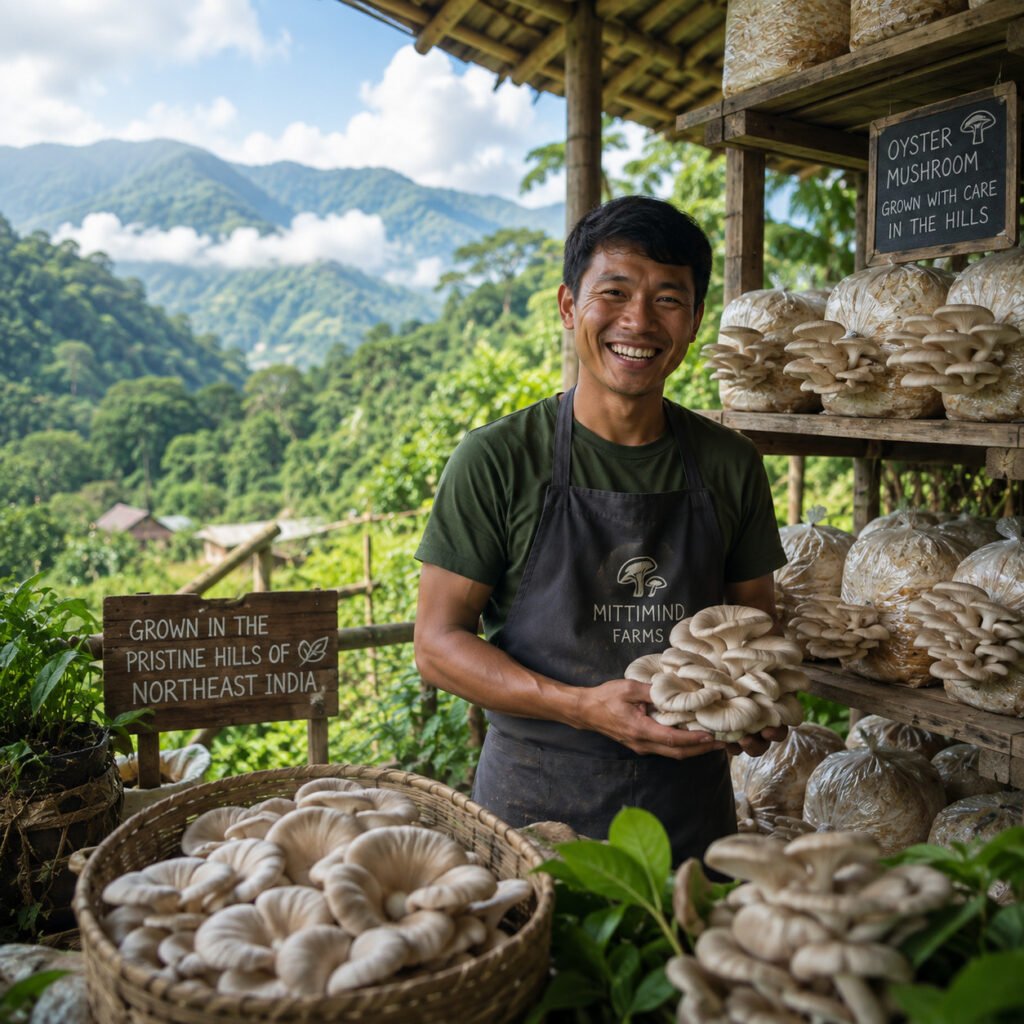
This calculator models your cultivation batch using commercial baseline parameters across major cultivated species (Pleurotus ostreatus, Lentinula edodes, Calocybe indica, and Agaricus bisporus).
1. Mushroom Variety Preset
- What it is: A quick-select menu that auto-populates realistic benchmarks for yield, market price, and production costs based on the specific mushroom strain.
- Why it matters: Different mushrooms have distinct environmental demands, biological conversion rates, and market values:
- Oyster (Pleurotus ostreatus): Fast colonizer (15–21 days), high conversion rate, hardy, ideal for beginners.
- Shiitake (Lentinula edodes): Longer incubation (60–90 days), high market value, requires hardwood sawdust substrate.
- Milky Mushroom (Calocybe indica): High heat tolerance (ideal for hot/humid plains), robust yield, firm shelf life.
- Button Mushroom (Agaricus bisporus): High demand, requires secondary composting and strict low-temperature climate control.
2. Number of Bags (Batch Scale)
- What it is: The total count of inoculated fruiting bags or blocks set up in a single production run.
- Why it matters: Scale directly impacts your fixed overhead efficiency. A 50-bag test run incurs roughly the same heating/sterilization overhead as a 200-bag run. Diluting your overhead across more bags lowers your production cost per kg.
3. Substrate Weight per Bag (kg)
- What it is: The total hydrated/wet weight of the prepared growing medium packed into an individual polybag before inoculation.
- Benchmark:
- Standard commercial bags typically range between 2.0 kg to 2.5 kg.
- Smaller 1.0–1.5 kg bags colonize faster but dry out quicker; larger 3.0+ kg bags hold moisture longer but carry higher internal heat and contamination risks.
4. Biological Efficiency (% BE)
- What it is: The industry standard for measuring how efficiently the fungal mycelium converts substrate weight into fresh, harvestable mushrooms across all flushes.
- How it works: Fresh Mushroom Yield (kg) = (Total Fresh Harvest Weight / Total Substrate Weight) X 100
- Realistic Industry Ranges:
- Oyster: 60% – 100% (e.g., 2.5 kg bag @ 80% BE yields ~2.0 kg fresh mushrooms across 2–3 flushes)
- Milky: 70% – 100%
- Button: 50% – 75%
- Shiitake: 45% – 70%
5. Spawn Cost per Bag (₹)
- What it is: The cost of the grain- or sawdust-based fungal seed (spawn) required to inoculate one single bag.
- How to calculate:
- Recommended spawning rate is 2% to 4% of wet substrate weight (approx. 50g–100g per 2.5 kg bag).
- If 1 kg of commercial spawn costs ₹100–₹150 and inoculates 10–12 bags, your spawn cost is roughly ₹12 to ₹20 per bag.
6. Substrate & Preparation Cost per Bag (₹)
- What it is: The direct material cost of raw base medium, enrichment supplements, and packaging consumables per bag.
- What to include:
- Base Material: Paddy straw, wheat straw, sugarcane bagasse, or hardwood sawdust.
- Supplements: Rice/wheat bran, gypsum, or agricultural lime.
- Consumables: Heat-resistant Polypropylene (PP) bags, rubber bands/rings, and non-absorbent cotton plugs.
- Benchmark: Usually averages ₹10 to ₹25 per bag depending on local agricultural residue availability.
7. Expected Selling Price per kg (₹)
- What it is: The average net revenue earned per kilogram of fresh harvested mushroom.
- Market Channel Differences:
- Mandi / Wholesale: ₹100 – ₹160 / kg (fast liquidation, bulk volume, lower margins)
- Local Retail / Supermarkets: ₹180 – ₹250 / kg (moderate volume, packaged in punnets/perforated pouches)
- Direct-to-Consumer / Farm-to-Table / Gourmet: ₹300 – ₹500+ / kg (high margin, requires active marketing and direct logistics)
8. Batch Overheads (₹)
- What it is: Semi-variable and fixed operational costs required to maintain the batch environment that cannot be tied directly to a single bag.
- What to include:
- Sterilization Fuel/Energy: LPG cylinders, firewood, steam boiler fuel, or autoclave electricity.
- Grow Room Climate Control: Power consumed by humidifiers, exhaust fans, and misting lines.
- Sanitation & Lab Consumables: Bleach, hydrogen peroxide, formalin, 70% isopropyl alcohol, and gloves.
- Retail Packaging & Distribution: Outer boxes, ice packs, or local delivery fuel.